

Academic infighting is heating up. Six weeks ago, Vanderbilt and WashU dropped a report which argued that there is a deep intellectual rot in some areas of the humanities, particularly anthropology. When I talked about that report earlier, I called it the “Boghossian report,” since some of the main arguments towards the end of the report are taken pretty directly from Fear of Knowledge, a book written by the report’s lead author, the philosopher Paul Boghossian. (Not Peter Boghossian, Paul.) I also predicted that this report would be used as a cudgel against certain departments. Boy was I ever right about that. Now, not to toot my own horn, that was the easiest prediction to make, since the introduction to the report basically said “We are writing this report so that it can be used as a cudgel against certain departments.” And as it is written, so it is done.
In recent weeks, further reporting has added fuel to the fire. The Boghossian report called out anthropology in particular as a field that was quite badly corrupted by politically-motivated bad methodology, so the Chronicle of Higher Education interviewed Carolyn Rouse, the head of the American Anthropological Association, to give her an opportunity to respond to the charges against her discipline. I think Rouse handled the interview somewhat better than many of her critics are saying, but she did not acquit herself particularly well. And just a few days ago, the Wall Street Journal ran an article asking “Is it time to ‘liquidate’ the study of sociology?,” and the answer the article arrives at is a pretty clear “Yes.” Expect to see more of this kind of reporting and argument in the near future. The knives are out.
Of course, the Boghossian report has itself been the subject of wide criticism on a number of different fronts. I discussed some of those criticisms in my discussion of the report, and Boghossian himself recently wrote a response to his critics. But today I want to focus on a criticism of the Boghossian report by Derek Anderson. Anderson is a Senior Permanent Lecturer in Philosophy at Boston University and also - full disclosure - my cousin. (Please check out his article and subscribe to his Substack, the Derektatus.) Anderson raises two main points in his article. One of Anderson’s points is that the Boghossian report undermines academic freedom. The other is is that the kind of scholarship that is being done in the more political areas of the humanities is defensible, at least on its own terms. These two points are related; if the scholarship done in the humanities is defensible on its own terms, then there’s a real point of academic debate at issue, and it’s more than a little messed up to try to shortcut that debate by kicking the humanists out of the university. These are good enough points and raise big enough issues that I’m splitting my response into two parts to deal with the issues separately. Today we’re going to talk about academic freedom. Expect Part 2 on subjectivist theories of truth later this week.
Anderson is not a liberal; he describes himself as “some kind of radical leftist.” So his endorsement of the liberal principle of academic freedom is a kind of playing against type. Anderson says that liberalism is not the politics of an ideal society; an ideal society is one where everyone knows the true and the good and is oriented towards it. Rather, liberalism is a bit of non-ideal technology that we use to manage conflict between different groups that have conflicting values and conceptions of what an ideal society consists in. He also says that, as a leftist, he views the entire liberal project as having been a massive failure. But if there’s one thing that liberals got right, it’s the idea of free speech competing in the marketplace of ideas. While that ideal might not apply to all areas of society, it is certainly of central importance within academia, for it is within academia that ideas should contend against one another in an unstructured intellectual melee. Anything less gives up on the mission of the university.
As a liberal myself, I am deeply moved by this argument. And indeed, I’ve earlier argued that the principle of academic freedom is exceedingly important, such that reform must come from within the university itself. I stand by that; but as events have developed, it’s clear that this is a hard principle to apply in practice. Boghossian et al are calling out the critical humanities from their position as academics; this is a motion towards reform that is coming from within the university itself. Yet Anderson points out that, by involving the administration and tapping into larger political currents that are taking aim at the leftist bent of the critical humanities, it’s certainly not a purely academic dispute. The whole thing is drenched with politics, and that means that it’s not consistent with academic freedom.
It’s perhaps instructive to ask how an expulsion of the critical humanities from the university might happen in a way that is fully consistent with academic freedom. Perhaps it would look something like this: the members of the faculty gather together into a great auditorium, with the goal of establishing once and for all the intellectual quality of the critical humanities. Speakers come forward on both sides, arguments and counter-arguments are made. The debate rages for days, or longer - as long as it takes. But finally, the last word has been said, the entire community has been convinced of the epistemic failure of the critical humanities. The humanists hang their heads in shame and exit both the auditorium and campus, yet their steps are oddly light, as they have seen the error of their earlier ways and are proud to have participated honorably in the process. This, of course, is pure fantasy.
Here’s another tableau, perhaps more realistic, and more Kuhnian in spirit. The humanities are fully left alone. Work continues as it has, but doubts begin to creep in among the humanists. The old paradigm isn’t working anymore. This triggers a slow-moving civil war and a revolution in the critical humanities, which eventually results in the emergence of a new paradigm which the rest of us find more palatable. This is how the humanities got into their current state, and so it is, perhaps, how they can get out. This is more realistic as a conception of how academic change might occur within the humanities, but it seems to me to be equally unrealistic given the current political climate. Change within the humanities might be a long time coming indeed; most departments are quite thoroughly captured, and the mechanism of future reform is unclear. (In Kuhn’s model, we’re driven to a new paradigm by empirical failures of the old paradigm, but the humanities don’t work in terms of empirical success and failure; paradigms in the humanities are pure fashion). And while I certainly see the virtue in the rest of higher education circling the wagons, fending off the attackers, and giving the humanists time to figure things out for themselves, this is far from a costless strategy. We’ll suffer budget cuts and greater political interference of every kind in the meantime. Perhaps that’s worth it. But perhaps not.
The moral of the story is that, while Anderson thinks of liberalism as a kind of social technology, divorced from an ideal image of the perfect society, when it comes to the liberal principle of academic freedom, that gets things precisely backwards. Academic freedom is the ideal. But the real world is constituted by fallible humans, with their own politics and prerogatives, biases and material needs. The goal of any who would defend the academy must be to ensure the conditions for our survival given the political realities of the moment.
Anderson invokes the notion of a “marketplace of ideas,” arguing that a true marketplace of ideas must be laissez-faire, and this is why the protections of academic freedom are important. But again, this gets things backwards. In a market, if someone makes a bad product, then no one will buy it, and the producers will go out of business. For a marketplace of ideas to work similarly, there needs to be a mechanism whereby bad ideas are escorted from the scene if no one is buying. But, rather than facilitating such a process, the bureaucratic structure of the university (where decisions of merit are largely left internal to individual departments) works to shield academics from these kinds of intellectual market forces. The whole point of academic freedom is to insulate academics from intellectual market forces. Academic freedom is the freedom to keep on pursuing your ideas even if no one is buying them. This can be a good thing. The history of intellectual development is, in many cases, a history of people laboring alone to work out new ideas, considered to be cranks by the public and even their own colleagues, only to eventually be fantastically vindicated. (Of course, sometimes cranks are just cranks.)
But the insulation from intellectual market forces provided by academic freedom is not total. Rather, what happens is that the university puts itself as a shield between the individual scholar and market forces. The reputation of the university as a whole is put on the line by its practice of shielding individual researchers from the outside world. And while, again, this can be a good thing, it requires more than a little discretion on the part of the larger academic community. If the university is perceived as being a den of cranks, the whole institution will be brought down, along with all the good work that is done inside of it.
It must be emphasized that, while there is certainly a partisan element to the attack on higher education, the loss of faith in academia is bipartisan. According to a recent Gallup poll, trust in higher education is at all-time lows across the political spectrum. 23% of Republicans have “A great deal” or “quite a lot” of trust in higher education. Among independents, it’s 38%. And among Democrats, 50%. 50%, from those who we would hope to be our political saviors! These are huge drops from just a decade ago, when higher ed was trusted by majorities within all groups. We’ve lost about 20% support across the board. Republicans have been attacking higher education for decades, but the attacks only started to land about a decade ago. Why the change? Surely this drop has many causes. Yet it cannot escape notice that this drop has coincided with the spread of radical leftist ideas out of humanities departments.
I saw these tweets the other day from Josh Barro, a moderate Democrat, and they’re highly representative of sentiments I see every day from the left of center:
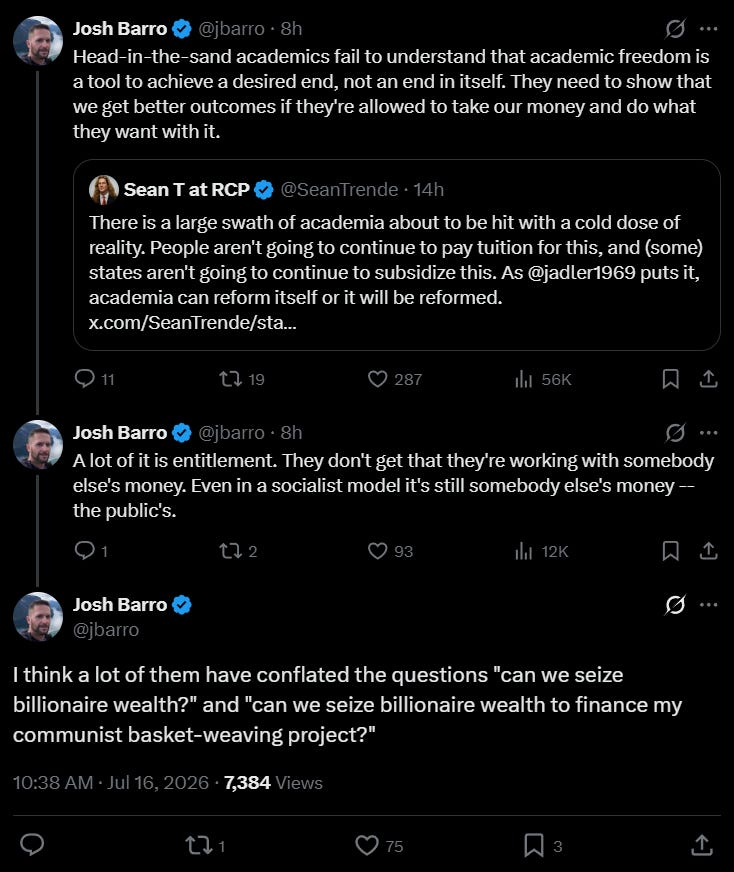
Again, Barro is a Democrat. And do note his attitude towards academic freedom. For Barro - and for most people, I’m sure - academic freedom is not a sacred and inviolable principle. It is a privilege that academics are granted by the public so long as we don’t abuse it. What counts as “abuse?” That’s an important question. In a perfect world, that would be resolved by a priori deduction from the One True Purpose of the university. In the actual world, the people decide, and the decision has gone against us.
Ideally, the humanities would do a better job of explaining their ideas and their value, and get the public back on side. Yet arguably the humanities’ success in communicating their ideas to the public is what caused the crisis in confidence in the first place! To take two examples: defunding police and the abolition of biological sex categories are two of the least possible ideas in politics today, and both are products of the critical humanities. If those ideas had stayed in unread academic journals, we might not be in this mess.
I do want to emphasize that this drop in support is not monocausal. There are lots of reasons why the public is angry at academia, Some of them are purely political, having to do with the ascendency of Trumpism and the attendant singling out of academics as an enemy. (Although if this was all that was going on, we’d expect support to be rising among Democrats.) Other causes of anger have to do with things like the ever-increasing price tag (which is kind of an illusory issue, but people don’t know that), changes in the labor market that make college less valuable (although it still has a positive value proposition), and a variety of ripple effects stemming from the wide availability of AI. So fixing the intellectual problems within the humanities will go only a small way towards restoring public trust in academia. But since a substantial part of the problem is popular anger at shoddy scholarship, fixing these epistemic problems is a necessary but not sufficient part of a larger package of needed academic reforms.
Against all of this, what role do appeals to academic freedom serve? As far as I can see, they simply serve to remind us that we are not in a perfect world. More’s the pity. But in this world, how shall we act? Perhaps by offering a serious academic critique of the critical humanities that is positioned to have real consequences. And that’s what the Boghossian report is.
Look, I’m not happy about this. My heart yearns for the Great Debate, and the defeat of bad ideas through pure intellectual contest. We’re solidly in the realm of the regrettable. But it’s time to think seriously about least bad options. 50% support from Democrats, and dropping. The hour is later than we think.
This brings us to Anderson’s second concern, the epistemology of the actual scholarship itself. Because again, the two critiques are intertwined. If there is intrinsically nothing wrong with the kind of scholarship that occurs within the critical humanities, then I would not be nearly so sanguine about throwing some sharp elbows as a way to head off political pressure. If the public turned decisively against evolution, we should still teach evolution. But if the work really is worthless, working to jettison it from the academy is a laudable act of epistemic hygiene.
Evaluating this aspect of the case is a big job, so I save it for Part 2.
The point for now is just that there’s no way to get around the responsibility of having to evaluate the case on its merits. If academia is to summon up a defense of the critical humanities, it needs to first do the work of looking at the scholarship that’s been done there, and seriously asking whether it is good enough to deserve our support.
And this is how we should understand the Boghossian report. Boghossian and his colleagues looked at the work that was done in the critical humanities, came to the conclusion that it was not good enough to deserve our support, and conveyed that conclusion to the administration of Vanderbilt and WashU. And if that is the decision about the quality of the work that we reach, what other conclusions should we draw? It’s one thing to disagree with what someone thinks, another to defend to the death their right to think it, and yet another to pay them a salary indefinitely to think it, putting the reputation of our institutions on the line in the process. I see nothing wrong with having a serious debate about which ideas are of high enough quality to be worthy of the protections of academic freedom. Nor is this stance self-contradictory. In a perfect world, academic freedom would be absolute. In the actual world, it is a guild privilege that we must jealously guard. This means being at least somewhat discerning about what ideas we appeal to academic freedom in order to protect.
Reform of higher education must come from within. But the Grand Debate where the quality of ideas is settled once and for all is a fantasy. And that means that reform must be driven by serious scholars doing their best to evaluate the quality of their colleagues’ work, with the conclusions conveyed, with appropriate care, to university leadership, because that is the forum where decisions that matter can be made. That is the process that is unfolding now. I hope it takes us to a better place.
Really nice post. One response I often see is that academia isn't really to blame for the decline in trust, as we've seen a decline in trust across lots of institutions. Looking for explanations specific to academia may be a mistake if we see the same thing when it comes to Journalism, Congress, the Supreme Court, the Presidency, etc. etc. Some relevant data here: https://news.gallup.com/poll/712436/confidence-institutions-remains-near-time-low.aspx
I think there's an element of truth to this, but it's mostly misleading. I think the element of truth is that we should be looking to general explanations of the decline in trust across the board, rather than treating the decline of trust in academia as sui generis. One explanation I find plausible is the rise of social media, and the increased transparency that it creates. Roughly, as people see more and more of the day to day operations of all sorts of institutions, cherry-picked for maximum engagement--more videos of police killings, more tweets from rage-baiting academics and journalists, etc.--they don't like what they see.
But it's mostly misleading because it's often used to imply--without stating it directly--that academics don't need to do anything special to react to the loss of trust, since it's not specifically about us. And that's just a non sequitur. Just as police departments need trust to work, and so need to react to the fact that cell-phone videos of their mistakes and misdeeds have fundamentally changed their relationship with the public--prompting reforms like body cameras, and other stuff about which there are ongoing conversations--so do academics need to react to the fact that, for whatever mix of reasons, financial support for universities is no longer the cold-button, slam dunk, bipartisan issue it once was.
"I think Rouse handled the interview somewhat better than many of her critics are saying"
Could you explain? She defended the censorship of the 2023 sexual dimorphism panel, and suggested that anybody who thinks dimorphism is a useful analytical framework must want to genocide intersex babies. I thought she did about as badly as she possibly could have.